
Are Non-Slip Tray Liners Food Safe?
By Kwickway Products · September 22, 2026 · 5 min read
Are Non-Slip Tray Liners Food Safe?
If you run food service, every item that touches a plate eventually gets questioned — by a health inspector, a procurement screen, or a client's own compliance team. Tray liners sit in an awkward spot in that conversation. They're not cookware, they're not packaging, and most operators have never been asked to justify them until suddenly they are.
Here's what actually matters, and what to ask before you commit to a supplier.
Direct contact vs. indirect contact
The first question is what the liner actually touches.
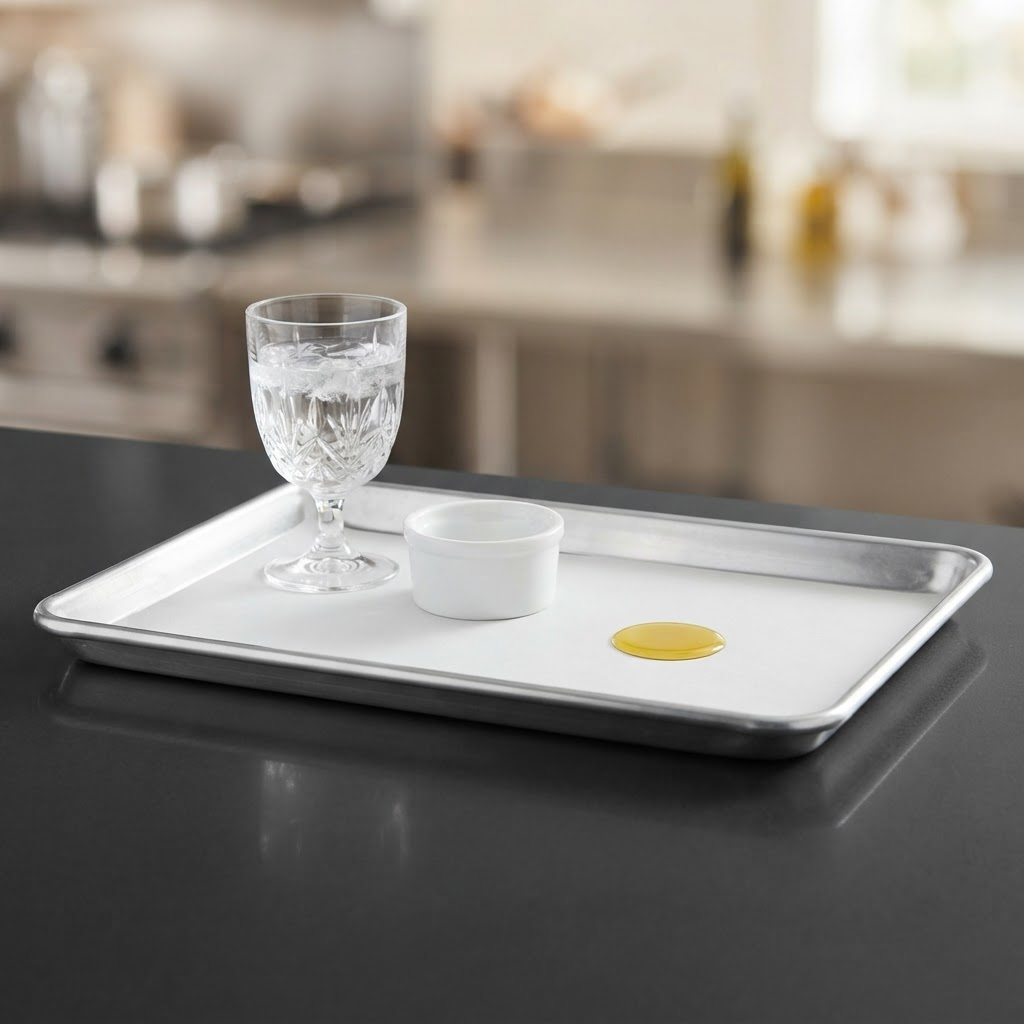
A liner under a plate, a glass, or a ramekin is in indirect contact with food. The vessel sits between the liner and anything edible. That's the overwhelming majority of tabletop liner use — banquet trays, bar coasters, room service trays, condiment caddies.
Direct contact is when food could reasonably land on the liner itself: an open buffet presentation, a bread service, a plated item that overhangs its dish. This is a different standard and a different conversation with your supplier.
Most operators assume they're in the second category when they're actually in the first. Work out which you are before you start asking questions, because it changes what evidence you need.
The three questions that matter
1. What is the material, specifically?
"Food-safe plastic" means nothing. You want the actual polymer. SlipSafe liners are thin-film polystyrene — a well-characterised material with decades of use in foodservice, not a proprietary blend nobody can name.
A supplier who can't tell you what their product is made of cannot tell you whether it's appropriate for your application.
2. Is it porous?
This is the question that separates products more than any other, and it's the one most operators skip.
A porous material absorbs. Water, grease, alcohol, sugar — all of it soaks in and stays. What's absorbed feeds bacteria, and once it's inside the material you cannot wipe it out. Standard rubber and PVC mats are porous. So is cloth. So is paper.
Non-porous means liquid sits on the surface and wipes away. Nothing penetrates, so nothing cultures. That's the entire hygiene argument in one property, and you can test it yourself in thirty seconds: put a drop of cooking oil on the liner, leave it a minute, wipe it off, and look at the surface. If there's a shadow, it's porous.
3. What happens to it under heat?
Ask what temperature range the product is rated for. A liner under a hot plate in a banquet run is in a different thermal environment than a bar coaster. If your service involves plate covers, heated trolleys, or hot-holding, say so when you ask.
Why porous mats fail hygiene audits
The failure mode is predictable and it's always the same.
A rubber or PVC mat goes into service looking fine. Over weeks it absorbs oils, alcohol, and spilled product. Adhesives and surface treatments break down on contact with those same substances — which means the grip degrades exactly as the contamination accumulates. Within days of heavy use, a mat that was tacky becomes slick.
Now you have a product that has stopped doing its job and is holding residue you can't remove. An inspector running a swab doesn't care that it looked clean.
The operational tell is that staff start replacing mats "because they've gone slippery" rather than on any schedule. If that's happening in your operation, the material is the problem, not the cleaning routine.
What paper-thin single-use liners do differently
A single-use liner sidesteps the cleaning question entirely. Every service starts with a surface that has never held anything — no accumulated residue, no wash cycle that might have failed, no cross-contamination between one guest and the next. There is no cleaning protocol to audit because there is no cleaning.
That's a stronger hygiene position than any reusable product can hold, and it's the reason single-use liners are standard in the environments with the tightest controls: healthcare tray service, airline catering, and cruise galleys.
Non-porosity still matters during the service itself. The liner doesn't absorb the condensation, grease, or spilled product it encounters over the course of a shift, so the grip doesn't degrade the way an absorbent surface does mid-use. SlipSafe liners hold vessels against slide up to 30 degrees of tilt while keeping vertical release force low — glasses stay put during a brisk walk across a room, then lift away cleanly when the server sets them down. That balance holds because the surface isn't being chemically broken down by what it's soaking up.
The edge matters too. A liner cut to fit the tray has a clean factory edge. A liner trimmed with scissors has a jagged, fibrous one — and that edge is exactly where residue collects and where a swab will find it. This is the practical reason to order the right size rather than cutting down a larger one, and it's a hygiene argument before it's an aesthetic one.
Putting it in a compliance submission
If you need to document this for a client, a franchise standard, or an internal audit, ask your supplier for:
| What to request | Why it matters |
|---|---|
| The specific material, named | "Food-safe plastic" is not an answer; the named polymer is |
| Porosity — with the oil test as your own verification | Non-porous is the core hygiene property |
| Temperature range | Confirms it suits your thermal environment |
| Manufacturing location and facility standards | Establishes the chain of production controls |
| Direct or indirect food contact | Sets which standard the auditor applies |
Then state your own use case plainly in the submission. "Indirect contact, under plated items, ambient to warm service" is a clear scope that an auditor can assess. Vagueness is what triggers follow-up questions.
The test you can run today
Take whatever you're currently using. Put a few drops of cooking oil on it. Wait a minute. Wipe it clean.
If you can see where the oil was, that material is absorbing what your service spills onto it — and it has been doing that for as long as it's been in your operation.
Request free samples and run the same test on a SlipSafe liner alongside it. It takes two minutes and it answers the question better than any spec sheet. If you're building a submission around specific trays, the complete sizing guide helps you order a clean factory edge instead of cutting one down, and the health-inspection breakdown covers why porous mats fail in more detail.