Casino Resort F&B: Keeping Service Steady On A 24-Hour Floor
By Kwickway Products · October 27, 2026 · 5 min read
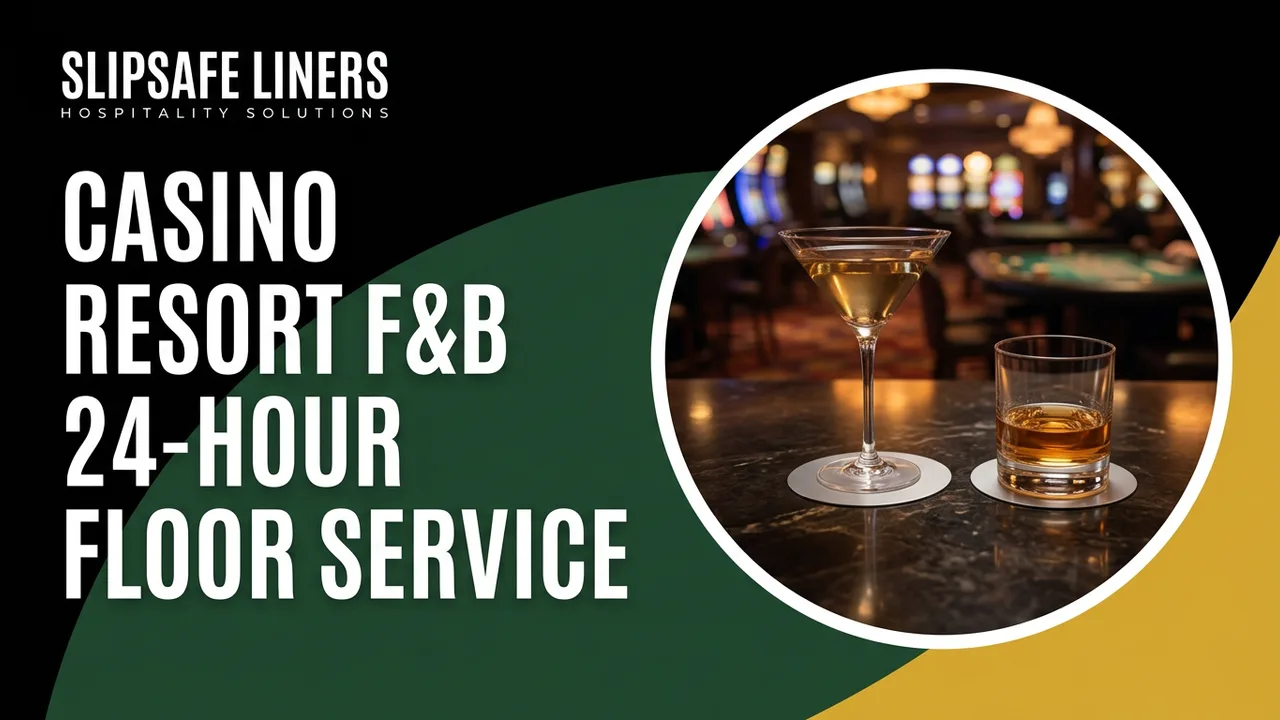
Casino resort food and beverage is the most demanding service environment in US hospitality, and it's the one least like a restaurant.
There are no seatings. There is no closing time. Beverage servers cover a moving floor plan with drinks in hand, weaving between players, walking on thick carpet, setting glasses onto felt, onto polished stone, onto rails. In a Las Vegas or Atlantic City property this runs 24 hours, seven days, every week of the year.
Why the casino floor is harder than a dining room
The surfaces change constantly. In a restaurant a server sets down on the same table finish all night. On a casino floor the same server is placing drinks on gaming table rails, cocktail tables, slot machine ledges, bar tops and side tables, glass, stone, laminate, wood and felt, sometimes within a single round.
The tray is always in motion. Cocktail service at a gaming table is delivered from a held tray, one-handed, at speed, in low light, between seated guests who aren't looking. The server rarely gets to set the tray down first.
Carpet is uneven. Thick patterned carpet over a subfloor with transitions, cable runs and thresholds means a tray is being jolted continuously rather than carried smoothly.
Condensation is constant. Iced drinks in a climate-controlled room sweat. Within minutes there's a film of water on the tray, and water between a glass base and a smooth tray is a lubricant.
Fatigue is structural. A 24-hour floor means overnight shifts, long rotations, and staff working the fourth hour of a graveyard. Technique degrades. That isn't a staffing failure, it's arithmetic.
What actually goes wrong
The incident is rarely dramatic. It's a glass that slides two inches as the server pivots, tips against another glass, and goes over, onto a gaming table, a player's chips, or a guest's clothing.
The costs stack differently than in a restaurant:
- The remake and the comp, standard
- The table. A spill on a live gaming table can mean a pause, a cleanup, and cards or chips out of play
- The guest, casino guests are high-value and the service recovery expectation is proportionally higher
- The carpet, casino floor carpet is expensive, custom, and difficult to spot-clean
- The electronics. A drink into a slot machine or table-side display is a service call, not a mop
A single incident on a gaming floor can cost several multiples of the same incident in a restaurant, which is why casino F&B teams tend to be unusually receptive to anything that reduces them.
What holds on a casino floor
Coasters on every surface. The most useful single product on a casino floor, because it makes the destination surface consistent regardless of what the destination actually is. Three sizes, 3-1/2", 4" and 5" diameter, cover cocktail through rocks and beer. Straight edge for contemporary rooms, scalloped for classic high-limit and lounge areas.
Tray liners for the cocktail tray. Full coverage, edge to edge. On a tray that's jolted continuously across carpet, the bare perimeter is where glasses walk.
Colour-coding across outlets. White, silver and blue across all lines. In a resort running a dozen F&B outlets plus the floor itself, colour-coding by outlet or by shift stops service ware migrating. Which on a property that size is a real inventory line.
Single-use, which matters more here than anywhere. A 24-hour floor has no natural downtime for a wash cycle. Liners are paper-thin and discarded after service, there's no sanitising protocol to run at 4am and no residue accumulating across three shifts.
The high-limit and VIP question
High-limit rooms, VIP lounges and host-managed service carry a different standard again. The presentation is part of the product, and a rubber bar mat is not acceptable in front of a guest being comped a suite.
This is where the silver stock and the scalloped edge earn their place. A liner that reads as a designed element rather than equipment, while doing the same job as everything on the main floor.
Running a floor test
Casino F&B directors tend to want evidence, not claims. The test is simple:
- Pick one outlet or one section of floor
- Log spills and breakage for two weeks, beverage servers will report them if you make it easy
- Introduce liners and coasters to that section only
- Log another two weeks against the same days of the week
A controlled comparison on your own floor is worth more than any supplier's demonstration, including ours.
Request free samples sized to your cocktail trays and bar service, and run the test. SlipSafe distributes regionally through a Las Vegas hub, with product shipping from Toronto and Buffalo, NY across the US.
FAQ
What do casino beverage servers use to stop drinks sliding on trays? Non-slip tray liners under the full tray surface, plus coasters at the point of service. The liner handles transit across carpet; the coaster makes the destination surface consistent whether it's a gaming rail, a stone bar or a cocktail table.
Are non-slip coasters suitable for gaming tables? Yes. They provide a stable, consistent surface on rails and side ledges where the finish varies, and they're supplied in white, silver and blue with straight or scalloped edges to match the room.
How do liners handle a 24-hour operation with no closing time? They're single-use and paper-thin, so there's no wash cycle to schedule and no residue building across shifts. A fresh liner goes down; the used one is discarded.
What coaster sizes are available? Three: 3-1/2", 4" and 5" diameter, in cases of 8,000, 6,000 and 5,000 units respectively.
Does SlipSafe supply Las Vegas properties? Yes. Las Vegas is one of the regional distribution hubs, supplied from Toronto and the Buffalo, NY US hub.