Custom Embossed Non-Slip Coasters For Hospitality Brands
By Kwickway Products · September 28, 2026 · 5 min read
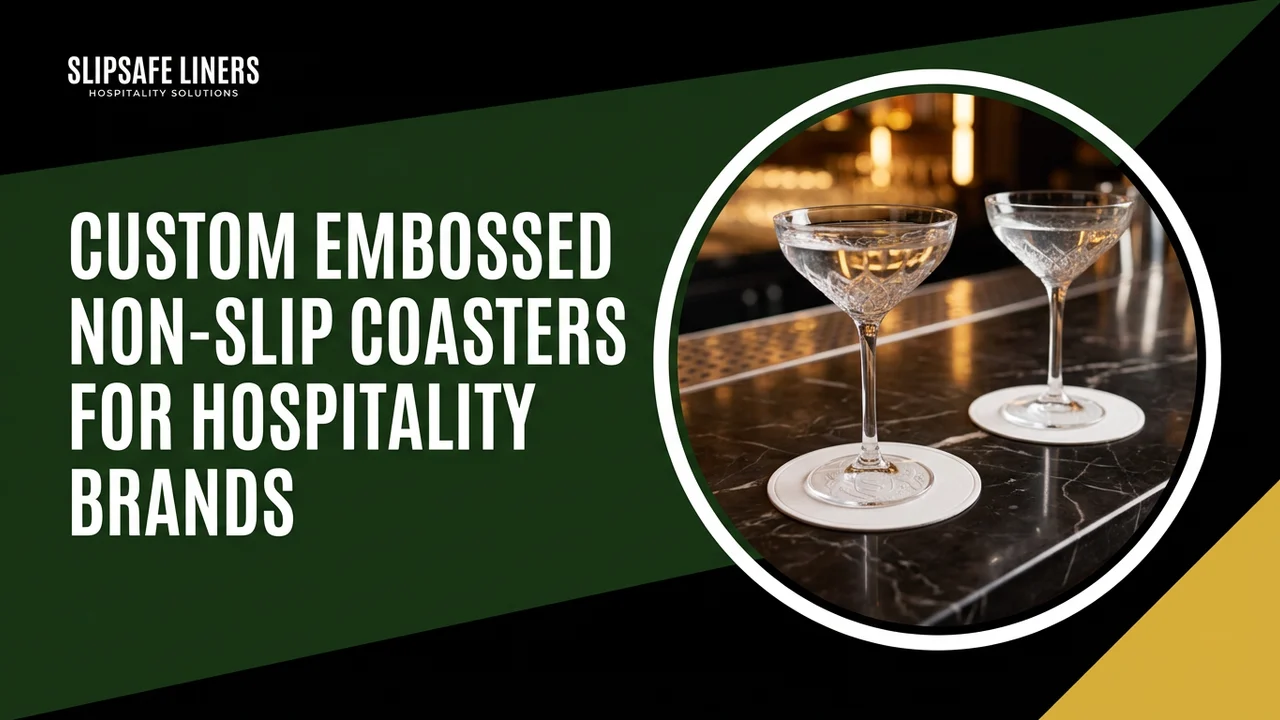
A coaster is the single piece of brand surface in your venue that a guest will physically touch, look at from six inches away, and keep in front of them for the length of a drink. No other collateral gets that.
Most operators still treat it as a consumable rather than a brand surface. Here's how to do it properly, and what a manufacturer needs from you to get it right.
What embossing actually is
Your logo is pressed into the polystyrene film itself. There's no ink. The mark is formed by the material — a raised impression that catches the light at an angle and reads tonally rather than by colour.
That's a different proposition from printing, and the difference drives every decision below.
What you gain. It's understated. A white crest on a white coaster reads as quality rather than advertising, which is exactly the register a luxury room wants. There's no ink to smudge, scuff or run, and a condensation ring doesn't obscure it — a printed detail under a sweating glass disappears, an embossed one doesn't. It's also tactile, which is the part guests notice without quite registering why.
What you give up. Colour. The coaster is white, silver or blue, and the mark is the same colour as the coaster. If your identity depends on a specific brand colour appearing on the piece, embossing won't deliver it.
What emboss well, and what doesn't
The film is paper-thin, so the constraints are real.
Works:
- Bold, simple marks — a wordmark, a monogram, a clean crest outline
- Strong, closed shapes with clear edges
- Generous spacing between elements
- A single mark, centred or slightly off-centre
Doesn't:
- Fine line work and hairline rules — they flatten out and disappear
- Small type. Anything under roughly 10pt loses definition
- Gradients, halftones and photographic imagery — there's no tonal range to work with, only depth
- Dense detail packed into a small area, where adjacent raised elements blur together
- Anything that relies on two colours to be legible
The honest test: if your logo still reads as a solid silhouette with the colour removed, it will emboss. If it needs colour contrast to be recognisable, it won't — and that's the conversation to have before artwork goes anywhere.
Keep clear of the rim. Leave the outer few millimetres alone. Die-cutting has tolerance, and a mark running to the edge will look inconsistent across a case.
Where branded coasters earn their cost
Hotel bars and lounges. A guest sits down, a coaster goes under the glass, and your mark is in front of them for twenty minutes. Multiply that by covers per night.
Room service and minibar. Often the only branded item on the tray, and the one that reaches the bedside table and stays there overnight.
Events and weddings. Venues increasingly want the tabletop to carry the identity. An embossed coaster is far cheaper than custom linen.
Golf and private clubs. Member-facing rooms where the crest on the coaster does the same work as the crest on the scorecard — and where understatement is the point.
Fine dining. The rooms where a printed logo would read as advertising and an embossed one reads as finish.
Size, stock and edge
Coasters run round in three standard sizes: 3-1/2", 4" and 5" diameter, supplied 8,000, 6,000 and 5,000 per case respectively. The 3-1/2" suits cocktail service where the coaster should read as a design element, not a mat. The larger sizes suit rocks glasses, beer and anything with a wide base.
Base stock is white, silver or blue. Silver is worth a look for embossed work specifically — the way it catches light at an angle gives the impression more definition than a flat white does, particularly under warm venue lighting.
Edge style is a brand decision and changes the read of the piece completely:
- Scalloped is traditional and formal — afternoon tea, classic hotel lounges, wedding and gala service, heritage clubs.
- Straight is contemporary and clean — modern bars, bistro decks, corporate events.
Grip is identical between the two.
What to send us
- Vector artwork — AI, EPS or PDF with outlined fonts. A PNG or JPEG can't be used to cut tooling.
- A single-colour version of your mark. Colour references aren't needed, since there's no ink — but we do need to know which elements are raised and which aren't.
- Size and edge — one of the three standard rounds, straight or scalloped.
- Base stock colour — white, silver or blue.
- Quantity. Products ship by the case; custom runs have their own minimums, confirmed on the quote.
If your artwork is complex, say so up front. It's a much shorter conversation than discovering it at proof stage.
One design or several?
Multi-outlet operations often ask whether to run one coaster across the property or a design per venue.
One design is simpler to order and store, and reinforces a single property identity. Right for most hotels under about four outlets.
Per-outlet designs make sense when the venues have genuinely distinct identities — a formal dining room and a rooftop bar are not the same brand, and a guest can tell. Running different base stock colours by outlet also gives you colour-coding for free: misplaced service ware sorts itself.
The storage and ordering complexity is the real trade-off, not the cost.
Proofing
Custom work runs longer than stock, so build in time for artwork review and a proof before production.
Look at the proof in the room where it'll be used, under that lighting — not on a desk and not on a screen. Embossed work is lighting-dependent in a way printed work isn't: a mark that's crisp under an office downlight can all but vanish under a dim lounge. That's the single most useful check you can make, and it takes two minutes.
For seasonal work — a holiday campaign, a wedding season, a signature annual event — start earlier than feels necessary.
Start with a sample
The fastest way to know whether this works for your venue is to hold the stock in your hand under your own lighting.
Request free samples in the sizes and edge styles you're considering, then send us your artwork and we'll come back with a quote and a proof.