
New Year's Eve: The Hardest Night Of The Year To Get Right
By Kwickway Products · November 14, 2026 · 5 min read
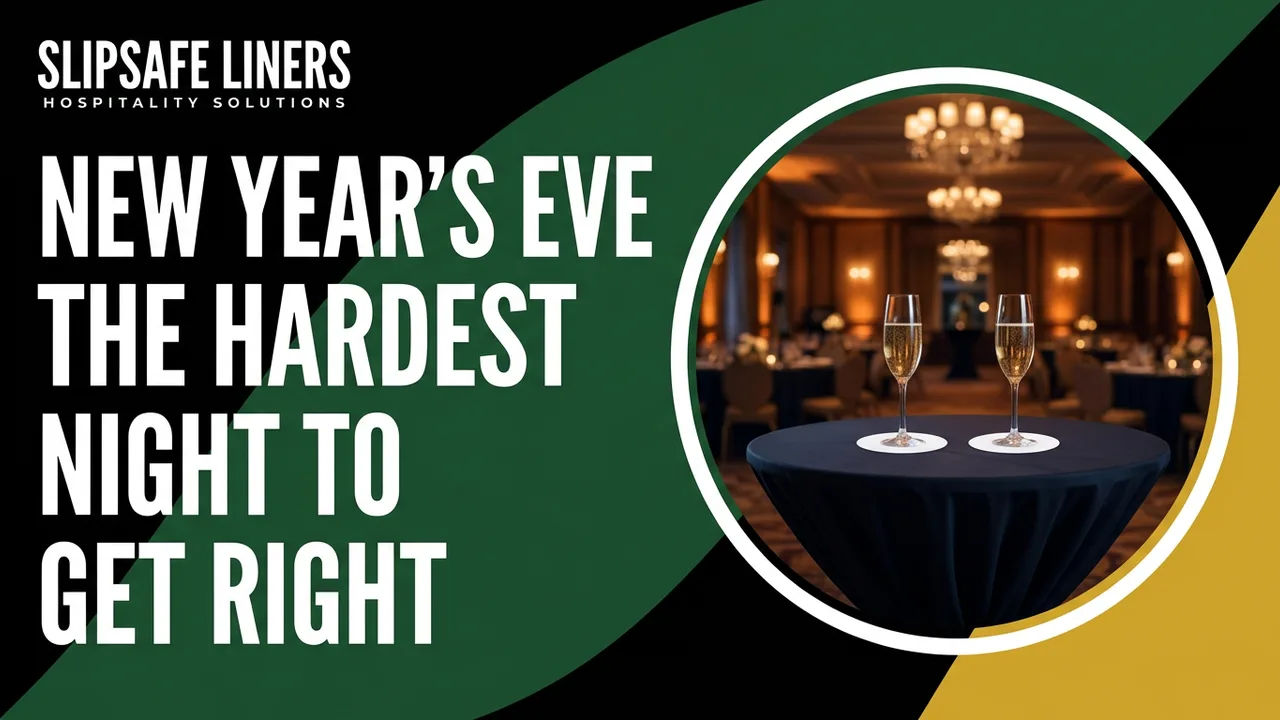
Most venues sell New Year's Eve at the highest price point of their calendar, to guests who have booked weeks ahead, for an evening with a fixed and very public climax.
It is also the single hardest service night of the year, and the preparation that matters happens in November.
What makes the night different
Volume is at its annual maximum. More covers, more drinks per cover, and a longer service window than any other night.
The lighting goes down and stays down. Servers who read tray edges and table surfaces comfortably at full light work the entire evening at a fraction of it.
The floor is packed and mobile. Dancing, photo lines, roaming entertainment, and a room that reconfigures itself hour by hour. The route briefed at six o'clock doesn't exist at eleven.
Guests are several hours in. By the time the floor is at its fullest, reaction times and spatial awareness across the room are not what they were at eight.
Midnight is a mass simultaneous movement. The entire room stands, turns, raises a glass, and moves at the same moment. Nothing else in the hospitality calendar does that.
Staff are the thinnest they'll be all year. Every venue in the market hired from the same casual pool in the same fortnight. Your floor has more first-timers on it than any other night.
The failure pattern
It's not a dropped tray in the kitchen. It's a glass knocked at a crowded high-top at 11:40, or a tray clipped by a guest crossing the room during the countdown, or a champagne flute set down on a wet bar rail that travels two inches and goes over.
The cost isn't the glass. It's that the incident happens in front of a full room at the moment the night is being judged, at the price point you charged.
What to prepare in November
1. Count what one comparable event consumes.
Run a December function and count. Tray liners scale with trays, not covers. A 300-cover plated dinner at eight plates per tray uses around 40 tray liners. Coasters and doilies scale with guests. Get both ratios once and you'll order accurately for every year after.
2. Order for the whole run, not the night.
Mid-November to January 2 is continuous, and the holiday party season guide covers the six weeks leading into it. Supply chains stretch in exactly the fortnight everyone orders. Products ship by the case with a one-case minimum, so carrying extra is inexpensive against the alternative. A venue running short mid-season and cutting a larger liner down with scissors, which leaves a jagged edge that lifts under plates and looks wrong six feet away.
3. Set the SKU list by service format.
| Format | Primary products |
|---|---|
| Seated dinner then dancing | Banquet oval or rectangular tray liners, doilies, coasters |
| Standing reception throughout | Coasters, full-coverage cocktail tray liners |
| Multi-room or multi-floor | Add blue stock for colour-coding by room |
| Private dining alongside | Doilies, ramekin and condiment liners |
4. Choose stock for the lighting.
Silver reads well under warm, low, theatrical light and photographs cleanly, which matters on the most photographed night of the year. White is the neutral under plated food.
5. Brief the casual staff on one behaviour.
Not technique. You can't build technique in a pre-shift. Brief them on set-down: put the tray down before unloading it. That single instruction prevents more incidents on the night than anything else you could say.
On the night
- Coasters on every surface a guest will set a drink on, including high-tops, bar rails and any prop or feature furniture brought in for the event
- Full coverage on every tray, no exposed rim, no trimmed edges. In low light a server can't see the tray edge clearly, and a glass set slightly off-centre needs grip under it rather than bare metal
- Walk the runner routes after the room is dressed, not at the site visit
- Extra stock behind the bar. This is the one night you cannot run out
Why the tabletop carries more weight on this night
Every variable that degrades service is at its worst simultaneously: visibility, floor density, staff experience, guest state, and volume. Training can't compensate for all five at once.
A liner performs identically at 8pm and at 12:30am, for a server on their second shift and one who has been there four years. It prevents sliding on smooth surfaces for up to 30 degrees while maintaining a low vertical release force, regardless of who's carrying the tray. That consistency is worth most on the night consistency is hardest to staff for.
Order before the calendar closes
If you're reading this in November, you're in the right window.
Request free samples sized to your trays and bar service, run one December function with them, and order the season against the count.
US orders ship from Toronto and our Buffalo, NY hub, with regional distribution through New York, Chicago, Miami, Las Vegas and Los Angeles.
FAQ
When should a venue order tabletop supplies for New Year's Eve? November. Supply chains stretch through December because every venue in the market orders in the same fortnight, and shortages hit mid-season when there's no room to absorb them.
How many tray liners does a New Year's Eve event need? Count trays rather than covers. A 300-cover plated dinner at eight plates per tray uses roughly 40 tray liners. Coasters and doilies scale with guests, so a drinks-led event consumes far more of those.
What should casual event staff be briefed on? Set the tray down before unloading it. It's teachable in a pre-shift and prevents more incidents than any other single instruction.
Which stock colour works best under event lighting? Silver reads well under warm, low lighting and photographs cleanly. White is the neutral choice under plated food. Blue is useful for colour-coding across multiple rooms or floors.
Why does low lighting matter for service? Servers judge tray edges and table surfaces visually. In a dimmed room that judgement degrades, so glasses are set closer to tray edges and onto surfaces the server hasn't clearly seen. Full-coverage liners remove the consequence.
What happens if we run short mid-season? The usual outcome is someone cutting a larger liner down with scissors, which leaves a jagged edge that lifts under plates and collects residue. Carrying a spare case is far cheaper.