
Non-Slip Liner Specifications For Hotel Brand Standards And RFPs
By Kwickway Products · October 9, 2026 · 6 min read
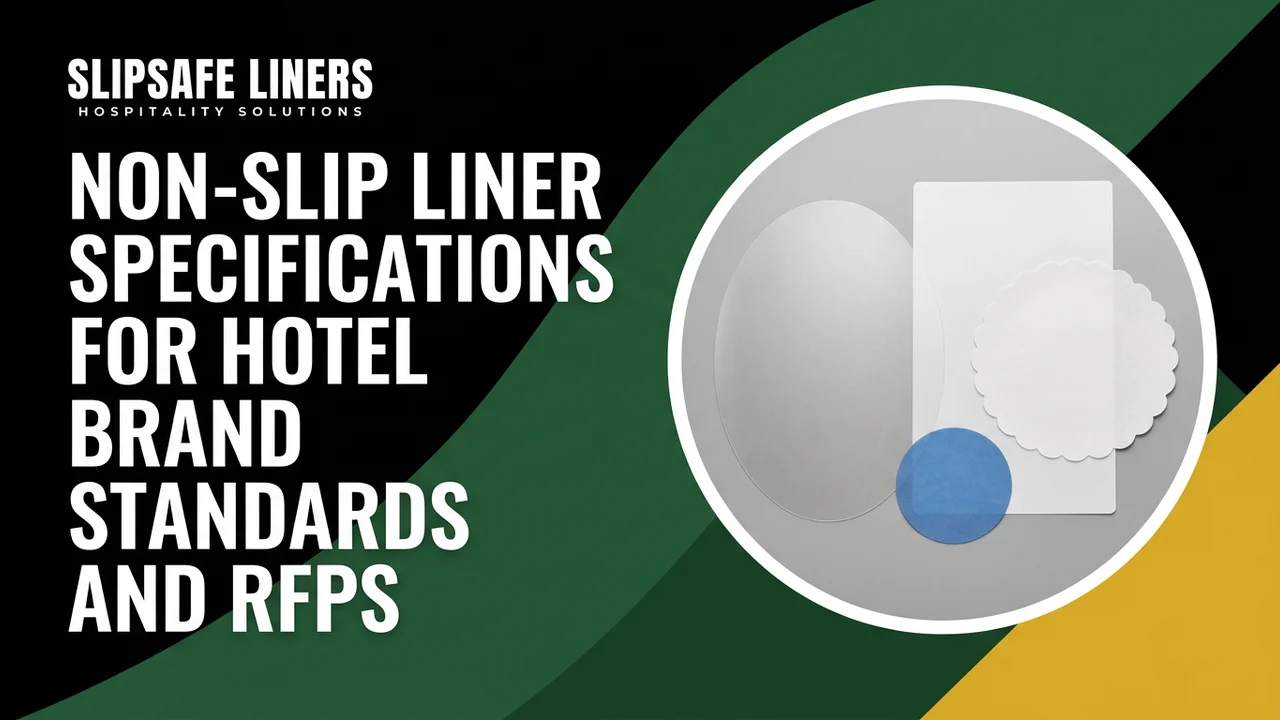
If you're writing a tabletop line into a brand standard, or issuing an RFP for a portfolio, you need specifications you can paste into a document. Not marketing copy. This page is that.
What are non-slip tabletop liners?
Non-slip tabletop liners are paper-thin, single-use film liners placed between service ware and the surface beneath it: a tray, a bar top, a plate, a trolley. They hold glassware and plated items against sliding during transport and service, then are discarded and replaced. They are manufactured in die-cut shapes and sizes matched to standard foodservice trays and vessels.
They are not rubber mats, shelf liner, or paper doilies. The distinction matters in a spec document, because those products behave differently and carry different hygiene profiles.
Material specification
| Attribute | Specification |
|---|---|
| Material | Thin-film polystyrene |
| Food-contact compliance | Manufactured from polystyrene complying with FDA 21 CFR 177.1640 (Indirect Food Additives: Polymers) |
| Construction | Paper-thin, die-cut |
| Porosity | Non-porous, does not absorb water, grease, alcohol or sugar |
| Use | Single-use; discarded after service, not washed or sanitised |
| Application | Placed beneath plates, glassware, ramekins and cups, not in direct contact with food |
| Recycled content | Up to 80% post-industrial recycled materials |
| Manufacturing | Die-cut at the Toronto, Ontario plant; solar-powered facility |
| Slide resistance | Prevents sliding on smooth surfaces for up to 30 degrees |
| Release | Maintains a low vertical release force, vessels lift away cleanly |
| Colours | White, Silver, Blue (all lines) |
| Edge finishes | Straight or scalloped on coaster, doily and ramekin lines; straight on tray liners |
The single-use specification is deliberate and worth stating explicitly in a brand standard. There is no wash cycle to validate, no sanitising protocol to audit, and no residue carried between guests. It is the same reason single-use liners are standard in airline catering and cruise galley service.
Food-contact compliance
SlipSafe liners are manufactured from thin-film polystyrene complying with 21 CFR 177.1640, the FDA regulation covering polystyrene and rubber-modified polystyrene. That section sits in Part 177, Indirect Food Additives: Polymers, Subpart B, which governs substances used as basic components of single and repeated use food-contact surfaces.
Two points worth getting right in a specification document:
The FDA does not certify or approve food-contact articles. There is no certificate and no approval number. Materials either comply with the applicable regulation or they don't, and the correct way to state it is compliance with 21 CFR 177.1640, not "FDA approved" or "FDA certified." A supplier offering you a certificate number for this is describing something that doesn't exist.
The compliance attaches to the material, not the finished article. The regulation covers the polystyrene itself. The liner is used beneath plates, glassware, ramekins and cups rather than in direct contact with food, which is why it falls under indirect food additives.
If your RFP requires documentation, request it directly from us rather than relying on a marketing page.
Size and case-pack specification
Coasters, round, straight or scalloped edge
| Size | Units per case |
|---|---|
| 3-1/2" diameter | 8,000 |
| 4" diameter | 6,000 |
| 5" diameter | 5,000 |
Doilies, round, straight or scalloped edge, 13 sizes from 6" to 15" diameter. Case packs run 4,000 units at 6"–8" and 2,000 units from 9" upward.
Ramekin liners, straight or scalloped edge
| Size | Units per case |
|---|---|
| 2" diameter | 12,000 |
| 3" diameter | 8,000 |
| 2-1/2" x 2-1/2" | 25,000 |
| 2-3/4" x 2-3/4" | 25,000 |
Condiment liners
| Size | Units per case |
|---|---|
| 3" x 2-1/2" | 25,000 |
| 3" x 6" | 10,000 |
| 2-1/2" x 10" | 8,000 |
| 4" x 12" | 2,000 |
Tray liners
| Size | Shape | Units per case |
|---|---|---|
| 10" x 14" | Rectangular | 2,000 |
| 14" x 18" | Rectangular | 2,000 |
| 16" x 22" | Rectangular | 2,000 |
| 12" x 12" | Square | 2,000 |
| 18" x 18" | Square | 2,000 |
| 19-5/16" x 24-1/4" | Oval (banquet) | 2,000 |
Custom die-cut sizes are available for non-standard trays and trolleys, common in purpose-built room service equipment and aircraft carts. Die cost is quoted separately.
Ordering and supply specification
- Minimum order: one case
- Shipping terms: F.O.B. Plant, Toronto, Ontario, Canada
- US distribution: Buffalo, NY hub, with regional distribution through New York, Chicago, Miami, Las Vegas and Los Angeles
- Also served: Vancouver, Montreal and Mexico City
- Samples: free, shipped to the property for evaluation before commitment
- Distributor programme: separate case pricing and MOQs, with protected North American territories
What an RFP should ask a liner supplier
If you're comparing vendors, these questions separate genuine specifications from marketing language:
- What is the material, named specifically? "Food-safe plastic" is not an answer.
- Is it porous or non-porous? Ask them to state it, then verify with the oil test: a drop of cooking oil, one minute, wipe clean. A shadow means it absorbs.
- Single-use or reusable, and which do you recommend for our application? A supplier who is vague here has not thought about your hygiene protocol.
- What are the exact case packs per size? Consumption planning is impossible without them.
- Can you produce custom dies, and at what volume does it make sense? Purpose-built trolleys are common in hotels.
- Where is it manufactured and where does it ship from? Freight distance affects lead time and resilience.
- What recycled content, and is it pre- or post-consumer? Ask for a percentage. SlipSafe liners use up to 80% post-industrial recycled material.
Writing it into a brand standard
Three fields make a standard enforceable across a portfolio:
Coverage. Specify full coverage of the tray's interior floor with no exposed rim and no trimmed edges. A scissor-cut liner is jagged, collects residue, and lifts under a plate. It should be explicitly out of standard.
Colour by outlet. White is neutral under plating. Silver reads premium under warm lighting and suits formal rooms. Blue is most often used for colour-coding, by outlet, by floor, or by shift, in portfolios large enough that mixed service ware is a real cost.
Edge by venue type. Scalloped for traditional and formal rooms, afternoon tea, and gala service. Straight for contemporary bars, bistro decks and corporate events. Grip is identical between the two; it's purely presentation.
Request specifications and samples
For a full spec sheet, current case pricing, or samples sized to your property's trays, contact our team or request free samples. Send tray dimensions and we'll confirm whether a standard size covers your fleet before quoting a custom die.
FAQ
What material are non-slip tray liners made from? Thin-film polystyrene, non-porous, so it never absorbs water, grease or alcohol. It is die-cut to size and supplied single-use.
Are SlipSafe liners FDA compliant? They are manufactured from polystyrene complying with FDA 21 CFR 177.1640, the regulation covering polystyrene and rubber-modified polystyrene under Part 177, Indirect Food Additives: Polymers. Note that the FDA does not certify or approve food-contact articles, so no certificate number exists for any product in this category. Documentation is available on request.
Are non-slip liners single-use or reusable? Single-use. Each liner serves one service and is replaced. That removes the wash cycle, the sanitising protocol, and any residue carried between guests.
What sizes do non-slip tray liners come in? Coasters in three sizes from 3-1/2" to 5"; doilies in 13 sizes from 6" to 15"; ramekin liners from 2" to 3"; condiment liners from 3" x 2-1/2" to 4" x 12"; rectangular, square and oval tray liners up to 19-5/16" x 24-1/4". Custom dies are available.
What is the minimum order? One case. Case packs range from 2,000 units on large tray liners to 25,000 on the smallest condiment and ramekin sizes.
Where do SlipSafe liners ship from for US properties? From the Buffalo, NY distribution hub, with regional distribution through New York, Chicago, Miami, Las Vegas and Los Angeles.
Can you match a custom tray size? Yes. Custom dies are cut at the Toronto plant. Send tray dimensions and SlipSafe will confirm whether a standard size already fits before quoting.