
Standardizing Tabletop Supply Across A Hotel Portfolio
By Kwickway Products · October 28, 2026 · 5 min read
Rolling anything across a hotel portfolio is a different problem from buying it for one property. The product question is usually settled in an afternoon. The rollout takes a quarter, and it fails for reasons that have nothing to do with the product.
Here's how tabletop consumables actually get standardised across multiple properties.
Start by counting trays, not properties
The instinct is to survey properties. The useful survey is of tray fleets.
Most portfolios discover they're running four or five distinct tray types across properties that were assumed to be identical. A mix of legacy stock, renovation-era purchases, and purpose-built room service trolleys that came with the building. Each one needs a liner that fits its interior floor, and a liner that doesn't fit gets trimmed with scissors, which produces a jagged edge that lifts under plates and collects residue.
Before you specify anything:
- Measure the flat interior floor of every distinct tray type in the portfolio, not the outer rim
- Subtract 3mm from each dimension; that's your target size
- Group properties by tray type, not by region
That grouping is what your SKU list should follow.
Rationalise the SKU list
Most portfolios can cover their entire estate with fewer SKUs than they expect. A realistic starting list for a full-service property:
| Line | Typical role |
|---|---|
| Rectangular tray liner | Bar service, bussing, room service trolleys |
| Banquet oval tray liner | Plated banquet and ballroom service |
| Coaster | Lounge, bar, in-room, poolside |
| Doilies | Plated presentation, afternoon tea, underliners |
| Ramekin / condiment liner | Sauce cups, condiment caddies, amenity trays |
Five lines covers most full-service hotels. A select-service property may need two. Fewer SKUs means simpler ordering, fewer wrong cases arriving at the wrong outlet, and a standard that properties will actually follow.
Where standard sizes don't fit, and purpose-built trolleys frequently don't, a single custom die can often replace three near-miss standard SKUs across the portfolio. That's usually where the rollout economics turn.
Design the pilot so it proves something
The most common rollout mistake is piloting everywhere at once and learning nothing.
A pilot that produces a defensible number looks like this:
- One property, two comparable outlets. One gets the liners, one doesn't.
- Two weeks before, two weeks after, matched by day of the week.
- Log every breakage, front of house and dish pit. Most operations are surprised by the back-of-house number because it's invisible to the floor.
- Count consumables used against covers, so you have a real per-cover figure to order against.
Then the business case writes itself: current annual breakage cost, annual liner cost, and the observed reduction. Your own numbers, from your own property, rather than a supplier's claim.
Use colour as infrastructure
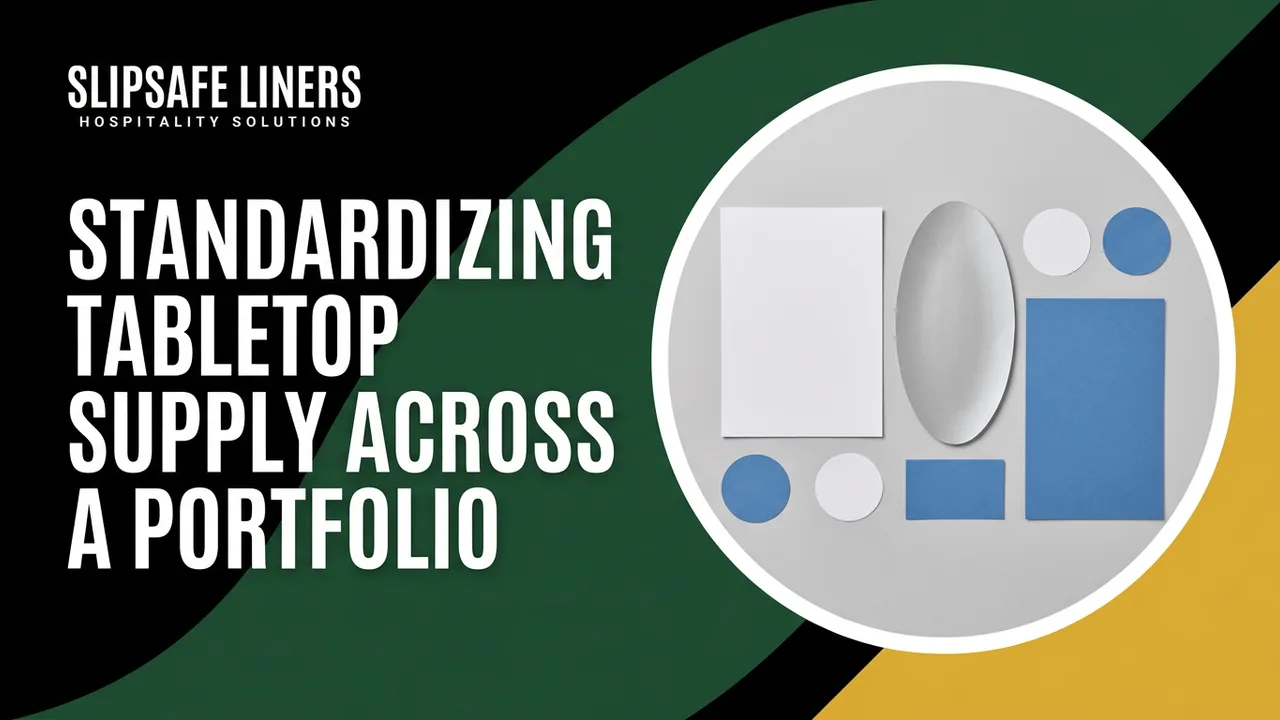
All lines come in white, silver and blue. In a single property that's an aesthetic choice. Across a portfolio it's an operations tool.
- White disappears under plating. The default for food presentation.
- Silver reads premium under warm lighting. Formal dining rooms, club lounges, gala service.
- Blue is the coding colour, by outlet, by floor, by shift, or by property within a cluster.
Colour-coding stops service ware migrating between outlets, which in a large property is a genuine inventory cost and in a portfolio with shared warehousing is a bigger one.
Edge style works the same way: scalloped for traditional and formal rooms, straight for contemporary. Grip is identical, so the choice is purely presentation and can be set per outlet type in the standard.
Write the ordering cadence into the standard
Rollouts decay at reorder. A property runs out mid-service, someone cuts a larger liner down, and within a month the standard is theoretical.
Three things prevent it:
A per-cover consumption figure per outlet type. Banquet, bar, room service and restaurant produce completely different ratios. Averaging them gives a number that's wrong everywhere.
A reorder point, not a reorder habit. Products ship by the case with a one-case minimum, so a spare case is cheap insurance against the failure above.
Seasonal pre-ordering. Wedding season, conference season and holiday banqueting should be stocked ahead, not into.
Decide the supply route
Two routes, and portfolios use both:
Direct gives you factory-fresh product, custom sizing, and a single relationship for the whole estate. Best where the portfolio is concentrated and volumes are predictable.
Through your existing distributor keeps tabletop on the same invoice as the rest of your disposables and uses freight you're already paying for. SlipSafe operates a distributor programme with protected North American territories. If you have an incumbent broadline or disposables partner, ask whether they carry the line or would.
For US portfolios, stock ships from Toronto and Buffalo, NY, with regional distribution through New York, Chicago, Miami, Las Vegas and Los Angeles.
Start with the tray survey
Everything downstream depends on it. Measure your fleet, group your properties, and request free samples in the sizes that survey produces.
If the fleet includes non-standard trolleys, send us the dimensions and we'll tell you whether a stock size already covers it before anyone quotes a die.
FAQ
How many liner SKUs does a full-service hotel typically need? Usually five: rectangular tray liner, banquet oval, coaster, doilies, and a ramekin or condiment liner. Select-service properties often need two.
How do you run a pilot that proves the business case? One property, two comparable outlets, two weeks before and two weeks after, matched by day of week, logging breakage in both front of house and the dish pit. Compare against your own baseline rather than a supplier benchmark.
Can one custom size replace several standard SKUs across a portfolio? Often, yes. Where properties run near-miss tray sizes, a single custom die can consolidate three standard SKUs into one, simplifying ordering and reducing wrong-case deliveries.
What colours are available and how are they used across a portfolio? White, silver and blue across all lines. White under plating, silver for formal rooms, blue for colour-coding by outlet, floor, shift or property.
Can we buy through our existing foodservice distributor? Yes. SlipSafe runs a distributor programme with protected North American territories, so an incumbent broadline or disposables partner can carry the line.