Igloos, Heated Terraces And Winter Outdoor Dining
By Kwickway Products · October 29, 2026 · 5 min read
Winter outdoor dining stopped being a novelty. Heated domes, igloos, fire-pit terraces, covered patios and rooftop cabanas now run through winter at hotels, restaurants and clubs across the US, bookable, premium-priced, and reliably full.
They're also a service environment that nobody designed for service.
Why winter outdoor dining is difficult
The structures aren't back-of-house. A dome or igloo is a guest space dropped onto a terrace. There's no service station in it, no landing surface, and often no level floor. Every item arrives carried from inside.
The walk is outdoors. Servers cross an open terrace between the building and the structure, in cold, often in wind, sometimes on a surface with ice or snowmelt on it. This is the highest-risk carry in winter hospitality and it happens on every course.
Condensation runs backwards. In summer, cold drinks sweat in warm air. In winter, a warm room or heated dome full of people against cold outside air puts moisture on every surface, including the table, the tray, and the inside of the structure itself. Glasses sit on a wet table regardless of what's in them.
The furniture doesn't help. Outdoor tables are glass, stone, powder-coated metal or composite, all of them slick, all of them worse wet, and in winter they're wet more or less permanently.
Air movement adds to it. Patio heaters and fire pits push air around, and on an open terrace that combines with whatever wind is already there, so anything light on the table is unstable. Guests, meanwhile, are in coats and gloves, with the same reduced grip and restricted peripheral vision that comes with any cold-weather service.
What it costs when it goes wrong
Winter outdoor dining is premium-priced and heavily photographed. A dome booking is frequently a special occasion, an anniversary, a proposal, a company celebration, booked weeks ahead at a premium.
A spilled tray in that setting isn't a comped drink. It's a ruined occasion in a space the guest paid extra and waited for, in a structure the server has to walk back outside to fix.
There's also a practical consequence: a spill inside an enclosed dome, on soft furnishings, in winter, with no easy way to ventilate or dry it, takes that structure out of service for the rest of the night. That's the entire evening's revenue for that booking slot.
What holds
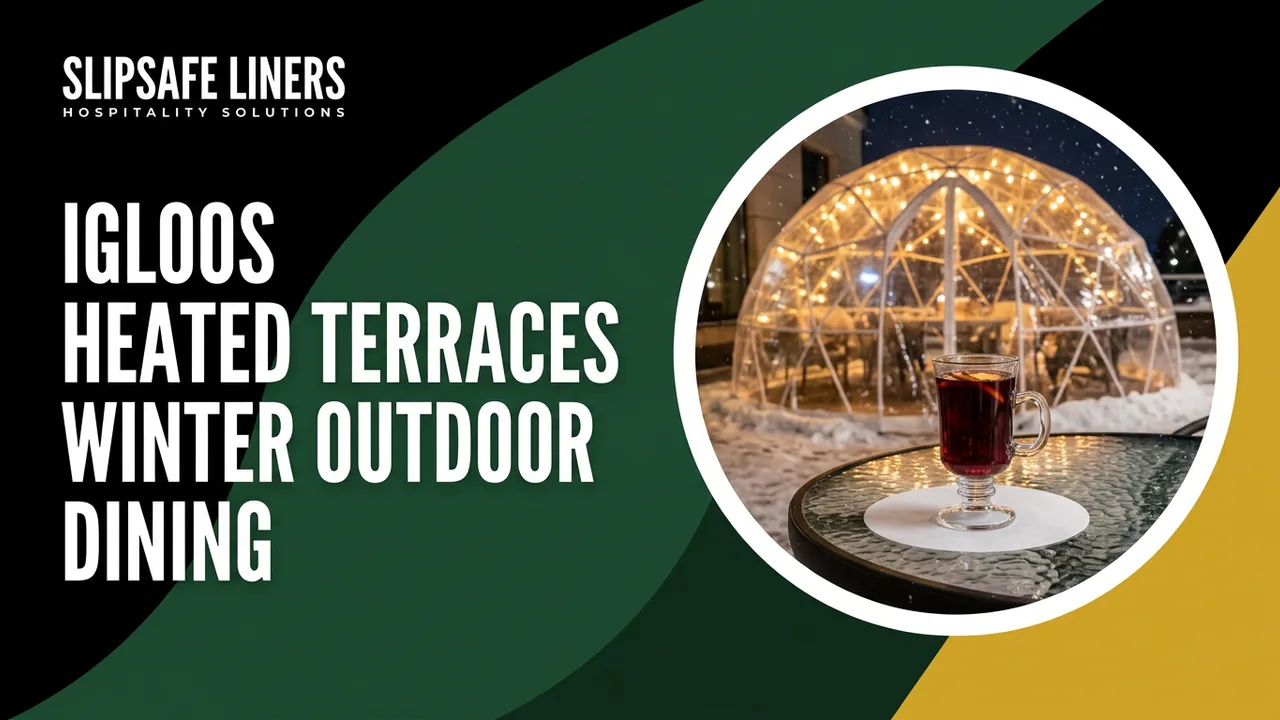
Coasters on every table. The single most useful product here, because it makes the table surface consistent whether it's a glass dome table, a stone terrace top or a composite patio table. And it works whether that surface is dry, damp or actively condensing. The 4" and 5" sizes suit the winter drink mix: mulled wine, hot toddies, rocks glasses, beer.
Full-coverage tray liners on the outdoor carry. The walk from the building to the structure is the risk. Full coverage, no exposed rim, means a glass set slightly off-centre is still held.
Weight that isn't weight. A paper doily or napkin on a heated terrace in air movement is gone. A non-slip liner is paper-thin but grips. It stays where it's placed. That's the whole argument for using it outdoors, and it's why venues that abandoned presentation on winter terraces can get it back.
Doilies for plated courses. Thirteen sizes from 6" to 15" cover plated and underliner presentation for the seated dining these structures are usually sold as.
Silver for the photography. Winter dome and fire-pit dining is shot constantly, string lights, low warm light, snow outside. Silver reads well in it. White is the neutral under food.
Single-use for an outdoor space. Terrace service ware collects grit, salt, ash from fire pits and meltwater. A single-use liner is discarded rather than carrying any of it into the next booking.
Practical setup notes
- Give each structure a landing surface. A small side table inside the dome lets the server set the tray down before unloading, which is the single behaviour that prevents most incidents.
- Clear and dry the carry route as part of the turnaround, not just the structure.
- Treat each structure as an outlet for stock purposes. If you're running eight igloos, that's eight simultaneous tables with their own consumption.
- Stock for the whole winter. Winter outdoor programmes run November through March in most markets, and resupply in January is slower than in October.
- Keep liners away from the heat source. Maximum service temperature is 158°F (70°C). Patio heaters and fire pits comfortably exceed that at close range, so don't set lined trays down on a surface directly beside a flame or under a radiant heater.
Markets where this runs hardest
Chicago, New York, Boston, Denver, Minneapolis and the northeast generally, where the contrast between cold outside and a heated dome is the entire product. Mountain resort towns, where slopeside fire-pit terraces run all season. And increasingly the sunbelt, where cooler winter evenings make covered patio dining the peak-season default rather than a novelty.
Test it in the cold
Don't evaluate winter outdoor product indoors.
Request free samples, take them out to the terrace on a cold evening, put a full glass on one, and see how it behaves on a wet table in moving air. Orders for US properties leave from Toronto and Buffalo, NY, with regional distribution through New York, Chicago, Miami, Las Vegas and Los Angeles.
FAQ
What stops drinks sliding on igloo and dome dining tables? A non-slip coaster between the glass and the table. Dome and terrace furniture is typically glass, stone or composite, and winter condensation keeps those surfaces damp. The coaster makes the landing surface consistent regardless.
Why do surfaces get wet in winter outdoor dining? Warm, occupied structures against cold outside air put condensation on tables, trays and the structure itself. It's the reverse of the summer problem but it produces the same wet, slick surface.
Will paper doilies work on a heated terrace? No. Patio heaters and fire pits move air, and anything light enough to be placed is light enough to leave. A non-slip liner grips the surface it's placed on, which is the practical difference.
What coaster sizes suit winter drink service? The 4" and 5" diameters suit mulled wine, hot toddies, rocks glasses and beer. The 3-1/2" is sized for cocktail service.
How should we stock for a winter outdoor programme? Treat each structure as its own outlet for consumption purposes and stock the full November-to-March run ahead of the season. Mid-winter resupply is slower than autumn ordering.