Restaurant Groups: Holding A Standard Across Every Room
By Kwickway Products · November 12, 2026 · 5 min read
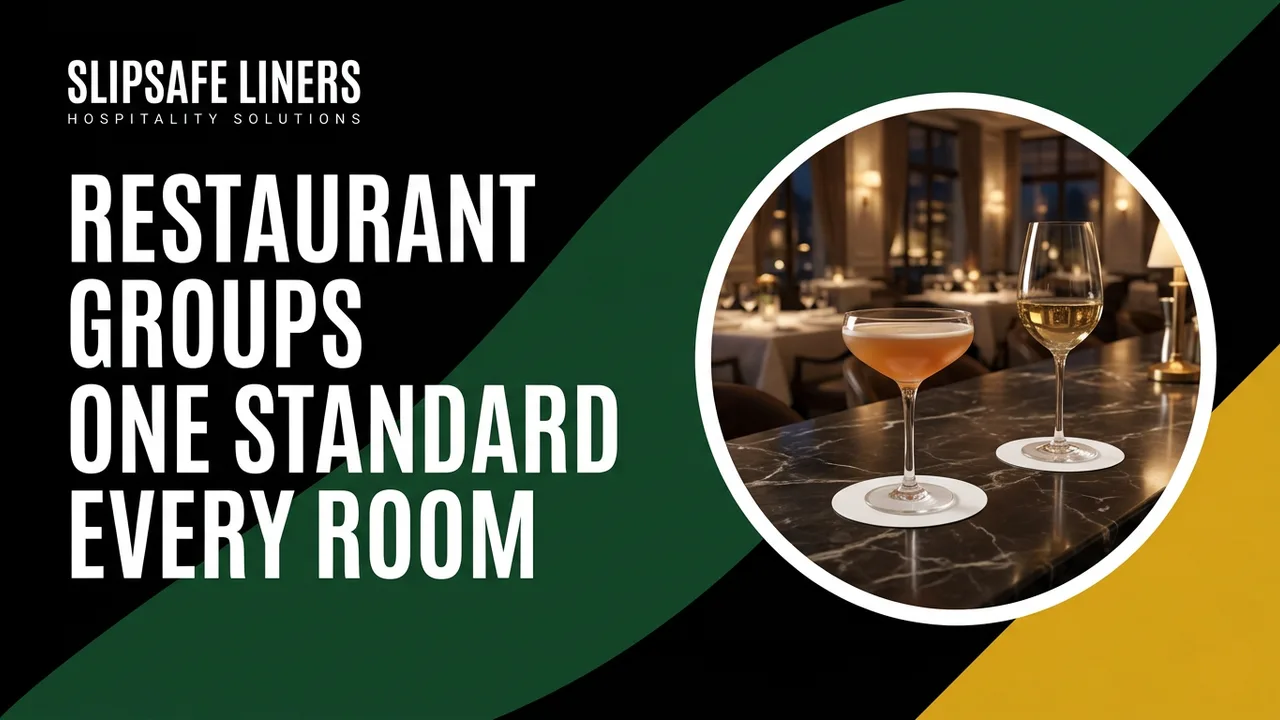
A restaurant group is judged on consistency. A guest who has a good night at one location and a sloppy one at another doesn't conclude that one room is weaker. They conclude the brand is unreliable.
Tabletop consumables are a small line item that shows up directly in that judgement, and they're one of the few things a group can genuinely standardise.
Where consistency actually breaks
Each location buys its own. Without a central standard, general managers order from whoever delivers. Within a year you have four different products across six rooms, in different colours, at different quality.
Opening teams improvise. A new location mobilises fast, somebody buys what's available locally, and that becomes the de facto standard for that room.
Nobody notices until a guest does. Tabletop is invisible when it's right. It only surfaces when a glass slides across a tray in a quiet dining room, or when the coaster under a cocktail looks cheap next to a $19 drink.
The back of house improvises harder. A room that runs out mid-service cuts a larger liner down with scissors. The jagged edge lifts under a plate, collects residue, and looks exactly like what it is.
What a group standard should fix
One product line, named. Not "non-slip liners" but the specific line, size and colour per application.
Coverage. Full coverage of the tray's interior floor, no exposed rim, no trimmed edges. Write scissor-cutting explicitly out of standard.
Colour by room type. White disappears under plated food. Silver reads premium under warm light and suits the higher-check rooms. Blue is for coding, which matters once service ware starts moving between locations or through a shared commissary.
Edge by concept. Scalloped reads traditional, suits a classic dining room or a hotel-style lounge. Straight reads contemporary, suits a modern bar or bistro. Grip is identical between them, so the choice is purely how the room should feel.
A standard list for a group
| Application | Line | Sizes |
|---|---|---|
| Bar and cocktail service | Coasters | 3", 3-1/2", 4", 5" |
| Bussing and bar trays | Rectangular tray liners | 10"x14", 14"x14", 16"x22" |
| Plated presentation | Doilies | 13 sizes, 6" to 15" |
| Sauce and condiment service | Ramekin and condiment liners | Four sizes each |
| Private dining and events | Banquet oval tray liners | 19-5/16" x 24-1/4" |
Five lines covers a full-service group. A fast-casual concept may need two.
All lines come in white, silver and blue, by the case, one-case minimum.
The specification to put in the ops manual
- Material: thin film foamed polystyrene, non-porous. Never absorbs water, grease or alcohol
- Use: single-use, discarded after service. No washing, no sanitising
- Grip: prevents sliding on smooth surfaces for up to 30 degrees while maintaining a low vertical release force
- Maximum service temperature: 158°F (70°C). Not for direct contact with hot plates or under heat lamps
- Food contact: manufactured from polystyrene complying with FDA 21 CFR 177.1640
- Recycled content: up to 80% post-industrial. Die-cut in Toronto, Ontario, and manufactured in a solar-powered facility
That last pair matters more than it used to. Groups increasingly publish sustainability positions, and a documented recycled-content figure with a named manufacturing facility is something you can actually stand behind.
Branding across a group
Embossed coasters are worth considering for a group with a defined identity. The mark is pressed into the film as a non-registered wallpaper pattern. No ink, so it's the same colour as the stock and reads tonally, catching the light at an angle.
For a higher-check room that's the right register: it reads as finish rather than advertising. It also survives a condensation ring, where printed detail disappears within minutes.
Minimum order quantities apply, so it suits a group ordering across locations better than a single room.
One design across the group reinforces a single identity. Separate designs per concept make sense when the concepts are genuinely distinct. A steakhouse and a rooftop bar are not the same brand, and running different base stock colours gives you location coding for free.
Rolling it out
Pilot in two comparable rooms. One gets the standard, one doesn't. Two weeks each, matched by day of week. Log breakage in both front of house and the dish pit. Most operators are surprised by the back-of-house number.
Count consumption per room type. A bar-led room and a plated dining room produce completely different ratios.
Set a reorder point per location. A spare case is cheap against a room improvising mid-service.
Try it in your busiest room
Request free samples sized to your trays and bar service, and run them through a weekend in the room that generates the most incidents.
US orders ship from Toronto and our Buffalo, NY hub, with regional distribution through New York, Chicago, Miami, Las Vegas and Los Angeles.
FAQ
How do restaurant groups keep tabletop consistent across locations? Specify the line, size and colour per application in the operations manual rather than leaving it to each general manager, and use colour-coding so compliance is visible. Standards that don't fit a room's actual equipment get replaced locally.
What sizes should a restaurant group stock? Usually coasters in 3", 3-1/2", 4" and 5"; rectangular tray liners in 10"x14", 14"x14" and 16"x22"; doilies across the 6" to 15" range; plus ramekin and condiment liners. Private dining adds the banquet oval.
Should liners be cut down to fit a smaller tray? No. A scissor-cut edge is jagged, collects residue, lifts under a plate and looks poor in front of guests. Order the correct size or request a custom die.
What's the difference between scalloped and straight edges? Presentation only, grip is identical. Scalloped reads traditional and suits classic dining rooms; straight reads contemporary and suits modern bars and bistros.
Can coasters carry our branding? Yes, embossed into the film as a non-registered wallpaper pattern. There's no ink, so the mark is the same colour as the stock. Minimum order quantities apply.
What temperature are the liners rated to? 158°F (70°C). Not for direct contact with hot plates or under heat lamps.