
Tray Service In Senior Living And Healthcare: Specifying For Dignity
By Kwickway Products · November 4, 2026 · 6 min read
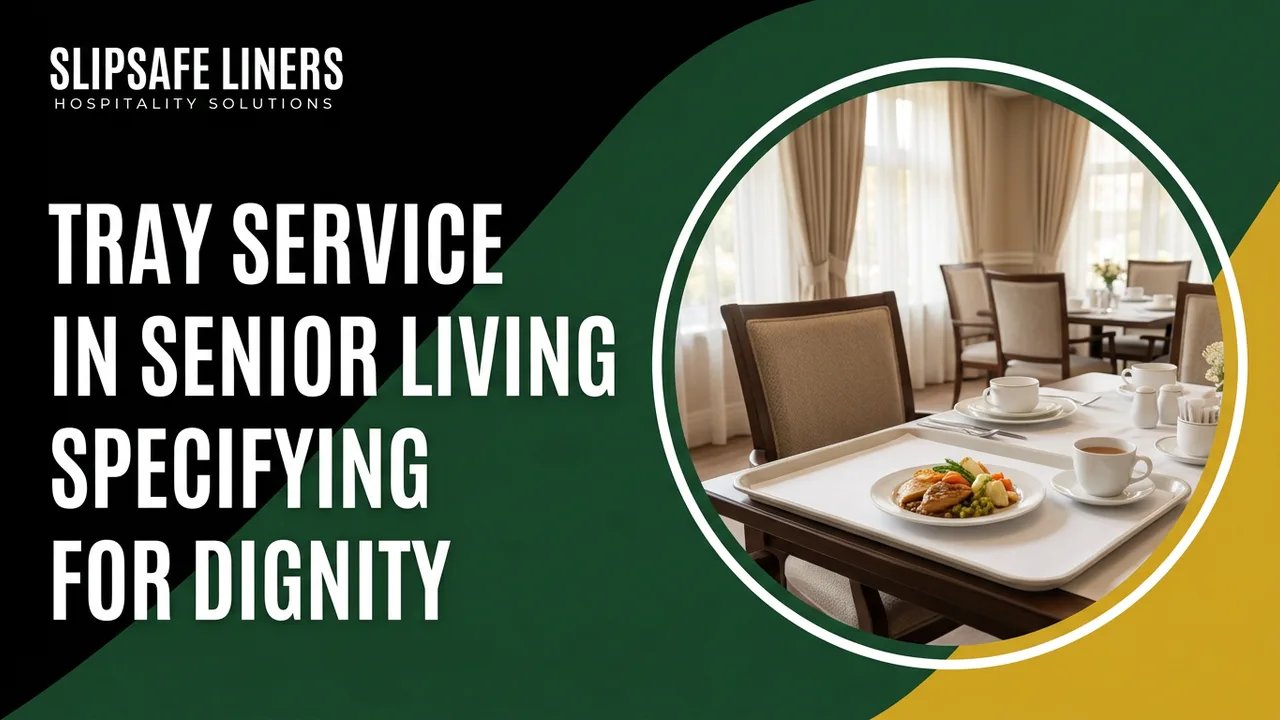
Most foodservice operations serve a guest once. Senior living serves the same resident three times a day, every day, for years.
That changes what matters. A detail a hotel guest never notices becomes something a resident sees a thousand times, and something their family notices on every visit.
What makes resident dining different
Volume is relentless and predictable. Three services a day, seven days a week, at a known cover count. There are no quiet weeks, but there are also no surprises, which makes consumption unusually easy to plan.
Dexterity varies widely. Residents with reduced grip strength, tremor, limited vision or arthritis are handling crockery and glassware themselves. A plate that slides when someone leans on it is a dignity problem before it's a cleaning one.
Trays travel. Room service to apartments, memory care dining, assisted living tray lines. Carried by staff across corridors, in and out of lifts, often one-handed while a door is managed.
Infection control is a documented standard. Anything reusable in a dining programme has to appear in a cleaning and sanitation procedure, be trained, and be auditable.
Families are the second audience. A resident's family forms their impression of the whole facility partly from how a meal looks. Presentation is part of what the fees buy.
Where tabletop supply earns its place
Dignity and independence. A liner under a plate means a resident can cut food without chasing the plate across the table. That's a small thing that matters enormously to someone whose independence is narrowing.
Spill reduction. Fewer spills means fewer clothing changes, fewer linen washes, less housekeeping, and fewer moments a resident finds embarrassing.
Staff time. Dining room turnarounds in senior living are tight and staffed thinly. Every avoided spill is minutes back.
Infection control simplicity. This is the one dining directors tend to appreciate most. SlipSafe liners are single-use: a fresh liner per service, discarded afterwards. There is no wash cycle to validate, no sanitation procedure to document for the item, and nothing carried between residents. For a facility maintaining auditable infection-control standards, that removes a line item rather than adding one.
Specification
- Material: thin film foamed polystyrene, non-porous. Never absorbs water, grease or spilled beverage
- Use: single-use, discarded after each service
- Grip: prevents sliding on smooth surfaces for up to 30 degrees while maintaining a low vertical release force. The second half matters here. A resident should be able to lift a cup away without the liner coming with it
- Maximum service temperature: 158°F (70°C). Not for direct contact with hot plates, under heat lamps, or inside heated holding trolleys. In normal service the plate or cup sits between the heat and the liner
- Food contact: manufactured from polystyrene complying with FDA 21 CFR 177.1640, under Part 177, Indirect Food Additives: Polymers
- Recycled content: up to 80% post-industrial. Die-cut in Toronto, Ontario, and manufactured in a solar-powered facility
- Colours: white, silver, blue
- Minimum order: one case
Matching product to setting
| Setting | Line |
|---|---|
| Assisted living tray line | Rectangular tray liners, 10"x14", 14"x14", 16"x22" |
| Main dining room, plated | Doilies, 13 sizes from 6" to 15" |
| In-apartment room service | Rectangular tray liners |
| Memory care dining | Doilies and coasters, in white for maximum contrast under crockery |
| Beverage service and lounges | Coasters, 3", 3-1/2", 4", 5" |
| Condiment and medication-adjacent service | Ramekin and condiment liners |
On colour: white gives the strongest contrast under most crockery, which helps residents with reduced vision locate the edge of a plate. That's worth more in this setting than the presentation argument that drives colour choice elsewhere.
Consumption planning is easier here than anywhere
Senior living has a known resident count and a fixed meal pattern, so the arithmetic is simple and stays accurate:
Annual units = residents × meals per day × 365 × liners per cover
Run a two-week count to establish liners per cover for each setting, then the annual figure holds. Unlike hotels or venues, there's no seasonality to absorb.
That predictability is worth using. Order against the annual figure with a reorder point rather than topping up ad hoc, and the dining programme never ends up improvising with the wrong size.
For multi-site operators
Groups running several communities should standardise on lines rather than a single SKU. The portfolio standardisation process is the same one hotel groups use, and let each site draw the sizes its tray fleet needs. Survey trays, not sites. Most groups find three or four distinct tray types across communities assumed to be identical.
Where a site runs purpose-built or inherited equipment, a custom die cut to the exact dimension is usually cheaper across a portfolio than carrying a near-miss size that gets trimmed with scissors at site level. A scissor-cut edge is jagged and collects residue, which in a healthcare setting is a harder conversation than in a restaurant.
North American coverage
The sector looks much the same on both sides of the border. US operators run assisted living, skilled nursing and continuing care dining programmes. Canadian operators run retirement residences and long-term care homes under provincial standards that are, if anything, more prescriptive about documented sanitation. The tray service problem is identical and so is the answer to it.
Canadian communities are served directly from the Toronto plant, with coverage across the Greater Toronto Area, Montreal and Vancouver. US orders ship from Toronto and our Buffalo, NY hub, with regional distribution through New York, Chicago, Miami, Las Vegas and Los Angeles.
A number of US communities already receive the line through their broadline foodservice partner rather than direct, so it is worth asking your existing distributor before opening a new account. Distributors evaluating the category can see how the line fits a disposables programme.
For the wider compliance picture in care settings, see healthcare compliance and anti-slip accessories and non-slip solutions for elderly care facilities.
Trial it in one dining room
Request free samples sized to your trays and run them in one dining room for two weeks. Count spills before and after, and ask the dining staff, they'll tell you quickly whether it changes anything.
FAQ
Do non-slip liners need a sanitation procedure in an infection control plan? No. They are single-use and discarded after each service, so there is no wash cycle to validate and no cleaning procedure to document for the item.
How do liners help residents with reduced grip strength? They hold the plate or cup in place so a resident can cut food or set a drink down without the vessel sliding. The low vertical release force means items still lift away easily, which matters for someone with limited strength.
What colour works best in resident dining? White gives the strongest contrast under most crockery, which helps residents with reduced vision locate the plate edge.
What temperature are the liners rated to? 158°F (70°C). They should not be placed in direct contact with hot plates or inside heated holding trolleys. In normal service the plate or cup sits between the heat source and the liner.
How do you calculate annual consumption for a community? Residents multiplied by meals per day, by 365, by liners per cover. Run a two-week count to establish the per-cover figure for each dining setting, then the annual number stays accurate because there's no seasonality.
Can we get sizes for purpose-built or inherited trays? Yes. Custom dies are cut in Toronto. Across a multi-site group, one custom die is often cheaper than carrying a near-miss standard size.
Do you supply retirement residences and long-term care homes in Canada? Yes. Canadian communities are served directly from the Toronto plant, including the Greater Toronto Area, Montreal and Vancouver.
Can we order through our existing foodservice distributor? Yes. We run a distributor programme with protected North American territories, so a broadline or disposables partner you already buy from can carry the line.